
Short answer: not every repair counts equally. Fixing a crack in the ceiling has far more effect on buyers than a new houseplant. Start with visible defects, then make the home fresh and neutral, and skip major renovations unless you have first calculated what they return.
When you are about to sell a house you ask yourself: where do I start, and what pays off? This article helps you choose on effect, not on price. It is part of our checklist for selling a house in the Netherlands.
Why one job counts more than another
Buyers judge a home within seconds, in photos and during the viewing. Visible defects such as a crack, a damp patch or a leaking tap read as a sign of neglected maintenance: what else can't I see? That raises questions and gives room to negotiate the price down. A nicely styled corner doesn't remove that signal.
That is why a simple rule of thumb works: the more visible the defect and the more doubt it creates, the greater the effect of repairing it. This is a rule of thumb from practice, not a measurement.
Which repairs have the most effect?
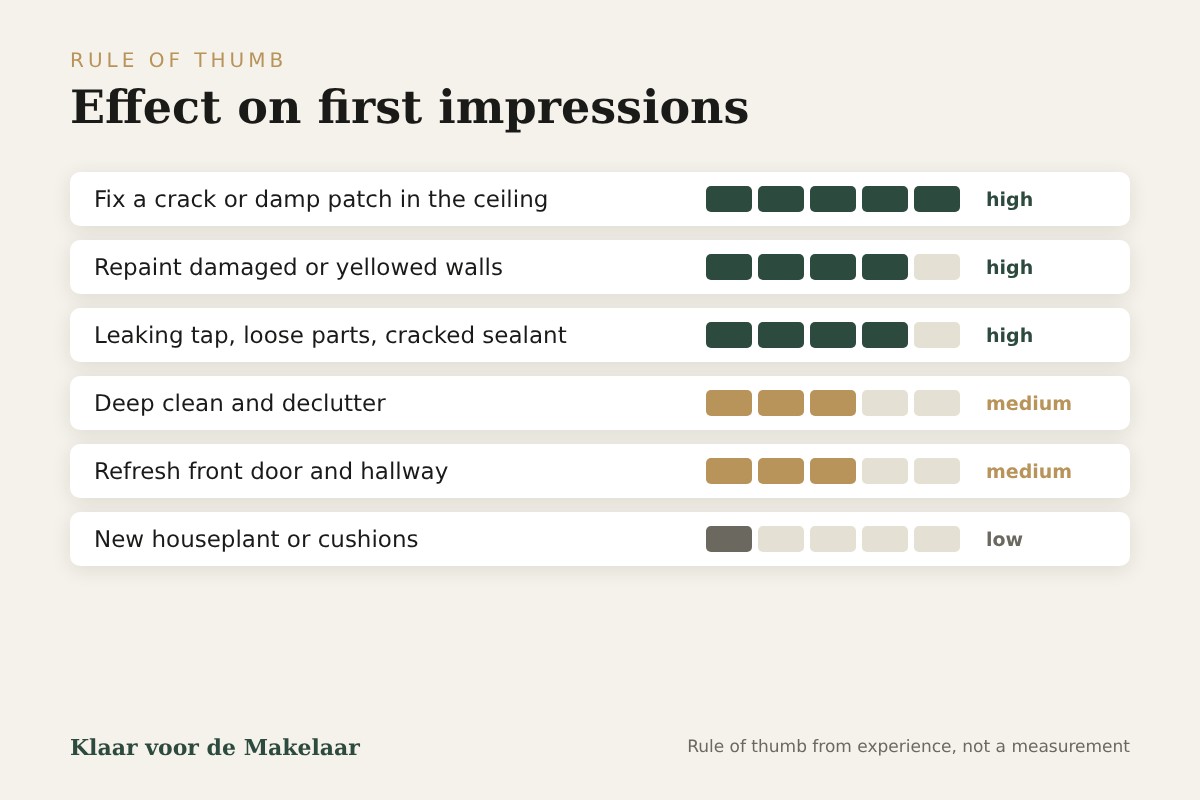
High effect
- Repair cracks and damp patches in ceilings or walls. They draw attention immediately and raise concerns about the condition of the home. If you have a damp problem you must disclose, do so honestly in the questionnaire (see checklist, step 7).
- Redo damaged or yellowed paint. A fresh, light wall makes rooms look bigger and photos better.
- Small repairs. Leaking tap, loose doorbell, sticking doors, cracked sealant or grout: small job, big signal.
Medium effect
- Thorough cleaning of windows, kitchen and bathroom.
- Decluttering and neutral furnishing. Fewer belongings give more space, and buyers can imagine themselves there more easily.
- Front door, hallway and exterior. First impressions start at the front door.
Low effect
- Decoration and accessories such as a new houseplant, cushions or pictures. They add atmosphere, but they don't solve any visible defect.
What does it return?
An honest answer: for the Netherlands we found no reliable research that expresses the return of getting a house sale-ready in euros. Anyone who promises a fixed percentage can't back that up.
What we do know is the market you are selling in. According to the NVM, the average selling time in the second quarter of 2026 was 28 days and 71% of homes sold above the last asking price (NVM market overview Q2 2026). In such a market you sell faster, but a home with visible defects still gives buyers a reason to hesitate or push the price down.
For staging there is US research: according to the National Association of Realtors, 49% of sellers' agents saw staging shorten the time on the market, and 29% said it raised offers by 1% to 10% (Scotsman Guide, 2025). Those are opinions of agents in another market, not a Dutch measurement. See it as a direction, not a promise.
What should you skip?
Major renovations, such as a new kitchen or bathroom. They quickly cost tens of thousands of euros and you don't automatically get that back in the sale price. Have an estate agent estimate the return before you invest. Also look at your energy label: that one is mandatory (see checklist, step 2).
Do it yourself or hire someone?
Decluttering, cleaning and simple jobs you can easily do yourself. For cracks, ceilings and visible paint or lacquer work the finish determines the result, and a sloppy job stands out in a photo. Not sure which repairs your home needs? See our before-and-after examples.
With the Ready-to-sell scan you get an objective overview of what your home needs and which repairs have the most effect. Klaar voor de Makelaar works with day rates, so you know the cost up front.
Book your Ready-to-sell scan →
FAQ
Which repairs have the most effect before you sell a house?
Repairs that remove visible defects: cracks and damp patches in ceilings or walls, damaged or yellowed paint, leaking taps, loose parts and cracked sealant. Buyers notice these immediately and read them as a sign of neglected maintenance. Decoration such as a new houseplant has far less effect.
Does getting a house sale-ready pay for itself?
No reliable Dutch research with hard return figures was found. US research by the NAR found that 49% of agents saw a shorter time on the market thanks to staging and 29% saw higher offers. Small repairs with a lot of visible effect are usually the best value.
Should I renovate my kitchen or bathroom before selling?
Usually not. Major renovations are expensive and you don't automatically get the money back in the sale price. Have an estate agent estimate the return first.
Is decluttering and a new houseplant enough?
No. Decluttering, cleaning and a bit of atmosphere help, but they don't replace repairing visible defects. A plant doesn't hide a crack in the ceiling.
What does it cost to get a house sale-ready?
That depends on what needs doing. Klaar voor de Makelaar works with day rates. Ask for a quote for your home so you know exactly what you will pay.